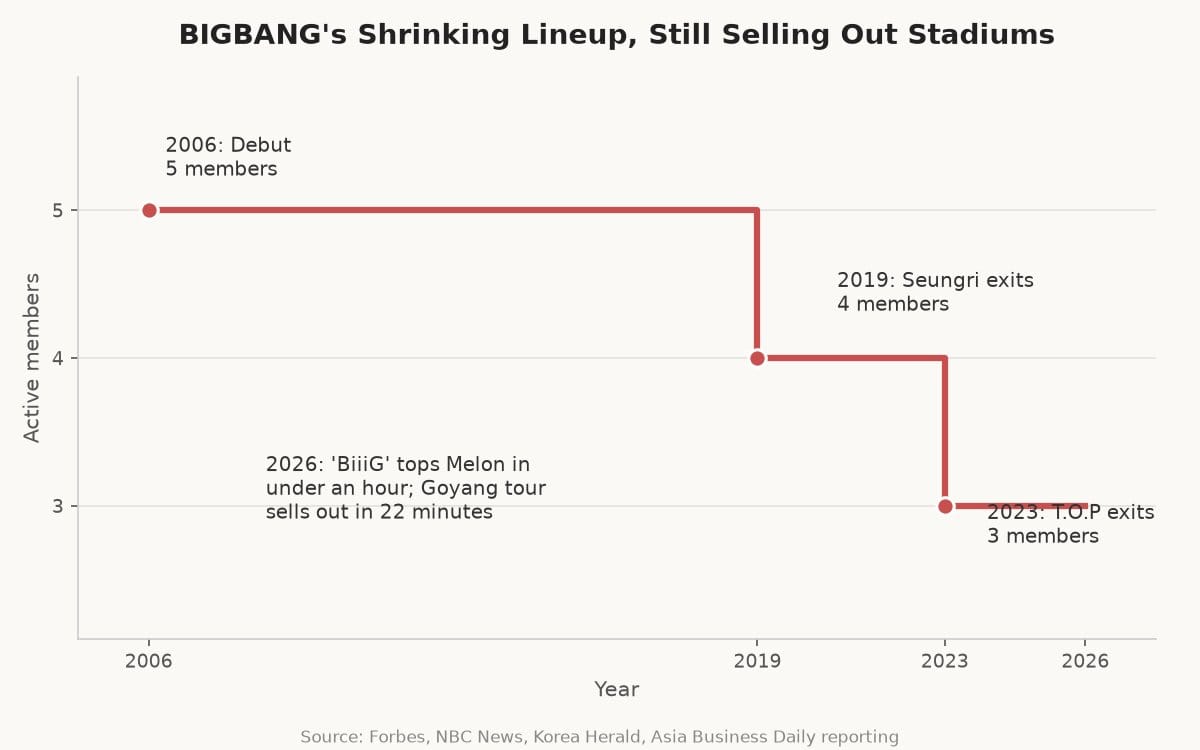
Two of Big Bang’s five founding members are gone. The group hasn’t released a full album since 2022. And on August 19, the anniversary of their 2006 debut, a K-pop group I just described in the most depressing possible terms topped every major music chart in Korea within an hour and sold out a three-night stadium run in 22 minutes. That’s the Big Bang 20th anniversary story nobody saw coming this year, and once you look at the actual numbers, it’s a genuinely wild case study in how legacy works in an industry that usually treats groups like fast fashion.

2006: Five Guys From YG Who Rewrote the Rulebook
Quick primer if you’re newer to K-pop: Big Bang debuted on August 19, 2006, at YG Family’s 10th anniversary concert in Seoul, after a member got cut mid-way through a reality documentary that aired on MTV Korea. The lineup that stuck — G-Dragon, T.O.P, Taeyang, Daesung, and Seungri — became what fans and critics still call the “Kings of K-pop,” and not just as a nickname. G-Dragon wrote and produced a huge chunk of their catalog himself, at a time when idols almost never got near a songwriting credit. That self-produced-idol template is the direct ancestor of what BTS and BLACKPINK do now — without Big Bang proving a boy band could write its own material and still headline arenas, the current generation’s playbook looks very different.

2019: The Scandal That Cost Them a Member
Seungri left the group in March 2019 after he was implicated in what became known as the Burning Sun scandal, tied to a Gangnam nightclub. He was later convicted on charges including arranging prostitution for investors and clients, embezzlement, and habitual gambling, and served prison time. It’s one of the ugliest chapters in modern K-pop, and it’s also the moment Big Bang went from a five-member group to a four-member one — a shift that would’ve ended most idol groups’ commercial relevance outright.
2023: Down to Three, and Everyone Assumed That Was It
Then in May 2023, T.O.P confirmed he’d also left Big Bang, ending his contract with YG after roughly 17 years with the label. That left G-Dragon, Taeyang, and Daesung as the only active members — 60% of the original lineup, for a group whose entire cultural cachet was built on five very specific personalities. This is usually the point where a K-pop group quietly stops existing. Members scatter into solo careers, acting, or normal life, and the group brand fades into “remember when.” Big Bang did not do that.

2026: The 20th Anniversary Comeback That Broke Melon in an Hour
On their 20th debut anniversary, Big Bang released “BiiiG,” their first new song since 2022’s “Still Life” — a gap of roughly four years and four months, which is an eternity in K-pop comeback math. It topped the real-time charts on Melon, Genie, Bugs, and Vibe within an hour of release, and according to Asia Business Daily, it logged the highest first-hour listener count of any song released in Korea in 2026 — beating out tracks from groups that are actively promoting, at full lineup, right now. Then came the tour math: all three nights of their “XX: Cosmos” world tour opener at Goyang Stadium sold out in 22 minutes, and the North American opening show at Oakland Coliseum reportedly sold out in 30, per Korea Portal. The tour itself runs 31 shows across 19 cities on four continents, stretching from this week through a February 28, 2027 finale in Kaohsiung, Taiwan. That’s a bigger footprint than plenty of currently-charting groups manage with a full five-plus lineup and a new album every few months.

Why a Three-Person Legacy Act Outselling Active Groups Actually Matters
Here’s the part that goes beyond “aw, nostalgia.” K-pop groups typically run on a roughly seven-year contract clock, and acts that lose 40% of their founding members to a criminal scandal and a label exit usually don’t get a “comeback” — they get a “where are they now” retrospective. Big Bang breaking that pattern says two things about the industry. First, the self-produced-idol model they pioneered gives artists a career durability idols on the standard system rarely get — G-Dragon and Taeyang spent two decades building individual artistic identities that don’t collapse just because the group shrinks. Second, it’s proof the global stadium infrastructure Big Bang helped build in the 2010s is now mature enough that a reduced, 20-years-in veteran act can out-hype a full-lineup 4th-generation group on a random Wednesday. The industry likes to talk about longevity in the abstract; Big Bang just put a number on it, and the number is 22 minutes.
you might also like



Sources:
- The Korea Herald: Big Bang’s 20th year celebration comes to Han River
- Korea JoongAng Daily: Big Bang releases ‘BiiiG’ for 20th anniversary, launches world tour
- Asia Business Daily: Big Bang’s First Song in 4 Years “BiiiG” Tops Music Charts
- Korea Portal: Big Bang Sold Out in 22 Minutes
- Forbes: BigBang’s Seungri Retires From K-pop Amid Prostitution Scandal