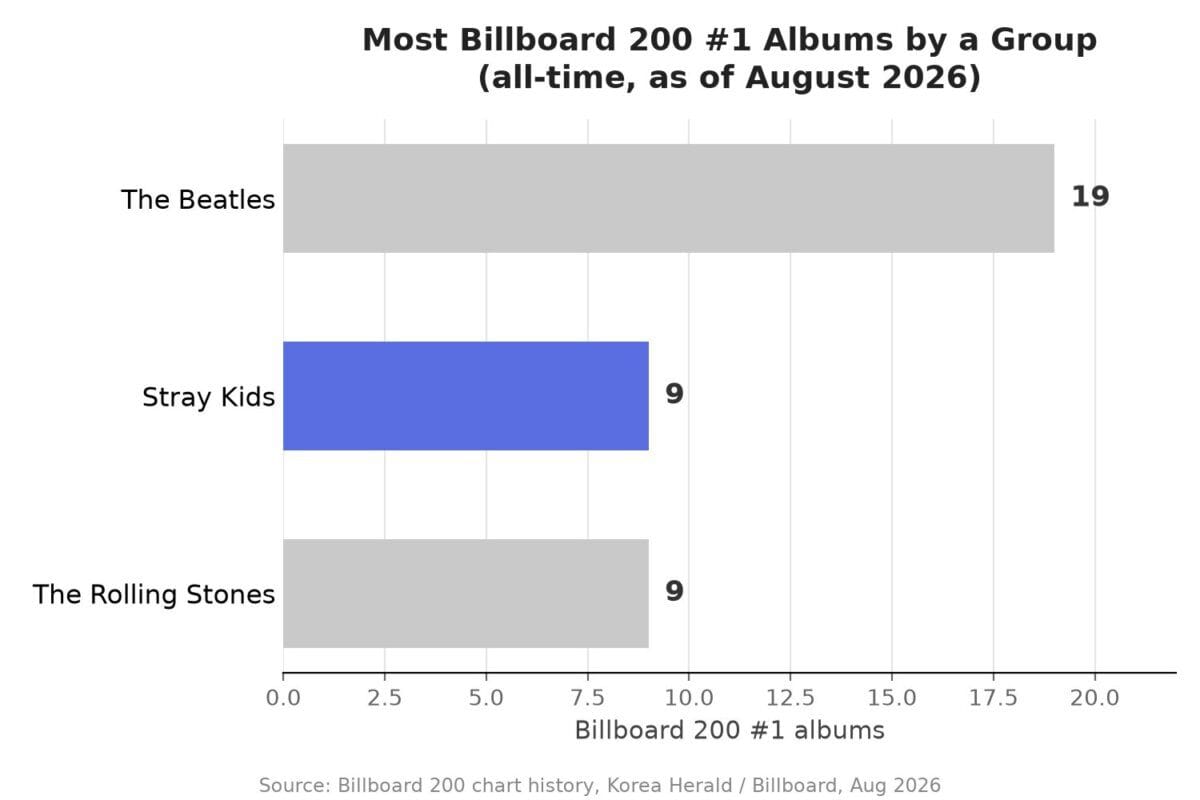
My roommate FaceTimed me at 11pm going “okay so apparently a boy band just tied THE ROLLING STONES on the Billboard chart” and I genuinely thought she was being dramatic. She was not being dramatic. Stray Kids’ new EP This & That debuted at No. 1 on the Billboard 200 on August 7, and that gives them nine career No. 1 albums — tying the Rolling Stones for the second-most Billboard 200 chart-toppers by any group, ever, behind only the Beatles’ 19. This is one of those Stray Kids Billboard 200 record stats that sounds made up until you check it yourself, so I did, and I have thoughts.
Wait, they did WHAT?
Every single one of Stray Kids’ nine charting albums has debuted at No. 1. Not “eventually reached No. 1.” Debuted. Week one, straight to the top, every time, since their first charting entry Oddinary in March 2022: Oddinary, Maxident, 5-Star, Rock-Star, Ate, Hop, Karma, Do It, and now This & That. According to the Korea Herald, that puts them at nine No. 1s among groups, tied with the Stones, trailing only the Beatles in the chart’s history dating back to 1956. The members themselves clocked the symbolism — they told press it “almost feels like fate” that the ninth Billboard 200 No. 1 landed in their ninth year since debuting in 2018.

How is a group your mom has never heard of doing this nine times in a row?
This is the part that actually matters, and it’s not magic — it’s math. This & That moved an estimated 369,000 equivalent album units in its first week in the US, per Billboard‘s tracking, which is Stray Kids’ biggest sales week to date. That number is overwhelmingly physical album sales, not streams, because K-pop albums come packaged with photocards — randomized collectible cards of each member that fans buy multiples of an album to chase. It’s the same mechanic that’s let groups like BTS and Seventeen dominate the Billboard 200 while barely denting radio. It’s not “cheating,” exactly, Billboard counts what it counts, but it does mean a Billboard 200 No. 1 measures something different for a K-pop act than it does for, say, an artist selling out arenas on Spotify streams alone. Nine consecutive No. 1s is still a real, extraordinary achievement of sustained fan mobilization — it’s just a different kind of dominance than the one the Rolling Stones built in the 1960s and 70s.
Okay but then why did the song only hit No. 38 on the Hot 100?
This is exactly the tension I just described, playing out in real time. The title track “This & That” debuted at No. 38 on the Billboard Hot 100 — which, per Korea JoongAng Daily, is actually Stray Kids’ highest-ever Hot 100 placement. Career-best, and still outside the top 30. That’s the album-versus-single split in a nutshell: the Hot 100 weighs radio airplay and on-demand streaming heavily, both of which still skew toward artists with US mainstream radio presence — something almost no K-pop act besides BTS has cracked consistently. So you get this weird split-screen: a group that’s now second all-time among groups on one Billboard chart, and still fighting for a top-30 single on another. Both numbers are real. They’re just measuring different fanbases.

Is this actually a big deal, or just a fandom stat?
Both, honestly, and I think that’s what makes it interesting instead of just a flex. On one hand, yes, “most consecutive No. 1 debuts” is a stat built for a press release. On the other hand, sustaining nine straight No. 1 debuts over four and a half years, through member enlistments, solo side-projects, and a genuinely oversaturated release calendar (there were something like nine other major comebacks the same month), is a real signal about how deep and how loyal the group’s global base is. It also matters for the K-pop industry’s bigger economic story — physical album exports just hit a record $257 million in the first half of 2026, and streaks like this one are a big part of why Western labels keep studying the K-pop playbook instead of dismissing it.

What happens next?
The Beatles’ 19 is still a long way off — that record was built across the entire pre-streaming album era, when “the album chart” and “popular music” were basically the same thing, so it may genuinely be unbeatable in the current fragmented-charts era. But tying the Rolling Stones, a band with six decades and 30 studio albums on Stray Kids, who’ve been a group for eight years, says the ceiling for K-pop acts on America’s biggest album chart is higher than the industry assumed even five years ago. If you’d told 2018-debut Stray Kids they’d be mentioned in the same sentence as the Stones by 2026, I don’t think even the members would’ve believed you. Their own quote about the “ninth in year nine” thing suggests they didn’t either.


you might also like


Sources
- Korea Herald — “Stray Kids earn career-best Hot 100 debut with ‘This & That'”
- Korea JoongAng Daily — “Stray Kids’ ‘This & That’ debuts at No. 38 on Billboard Hot 100”
- UPI — “Stray Kids’ ‘This & That’ tops album chart”
- Billboard — Chart Beat coverage of Stray Kids’ ninth Billboard 200 No. 1
- Wikipedia — Stray Kids discography and chart history