So I was doom-scrolling last night when NCT 127 dropped their comeback teaser for BLINGY, and my first thought wasn’t “ooh new music” — it was “wait, isn’t Doyoung in the military right now?” He is. So is Jungwoo. They’re doing mandatory K-pop military service right now, while their five bandmates promote an album without them, and somehow that’s treated as a normal Tuesday. Meanwhile on ENA, a black-comedy drama called New Recruit 4: Sabotage premiered on August 24, and it’s entirely about what that experience is like. If you’ve ever wondered “wait, why did my bias just vanish for a year and a half,” this is for you.
Okay, but what is New Recruit?
New Recruit (신병) is a franchise most Americans have never heard of because we have nothing like it. It’s a hyper-realistic military comedy, adapted from a webtoon, following conscripted soldiers through the mundane, absurd reality of mandatory service. Season 4 picks up with Kim Min-ho’s character now a corporal, dealing with a new commander, a returning rival, and an unreadable new recruit, airing Mondays and Tuesdays at 10pm KST.
Pitch that to an American network: a comedy about the draft. Not a war epic — a workplace-sitcom where the workplace is a military base and literally every man watching has lived it. That premise only works in a country where every guy in the audience has personally done this.
The numbers behind the hype
Season 3 climbed every single week last year. Per Nielsen Korea ratings compiled by Soompi, episode 3 pulled 2.3%, dipped to 2.3% again at episode 5, then rose for three straight weeks to 2.6%, 2.9%, and a series-high 3.3% at the finale. For a niche cable drama with no A-list leads, that upward climb means word of mouth carried it — not marketing.
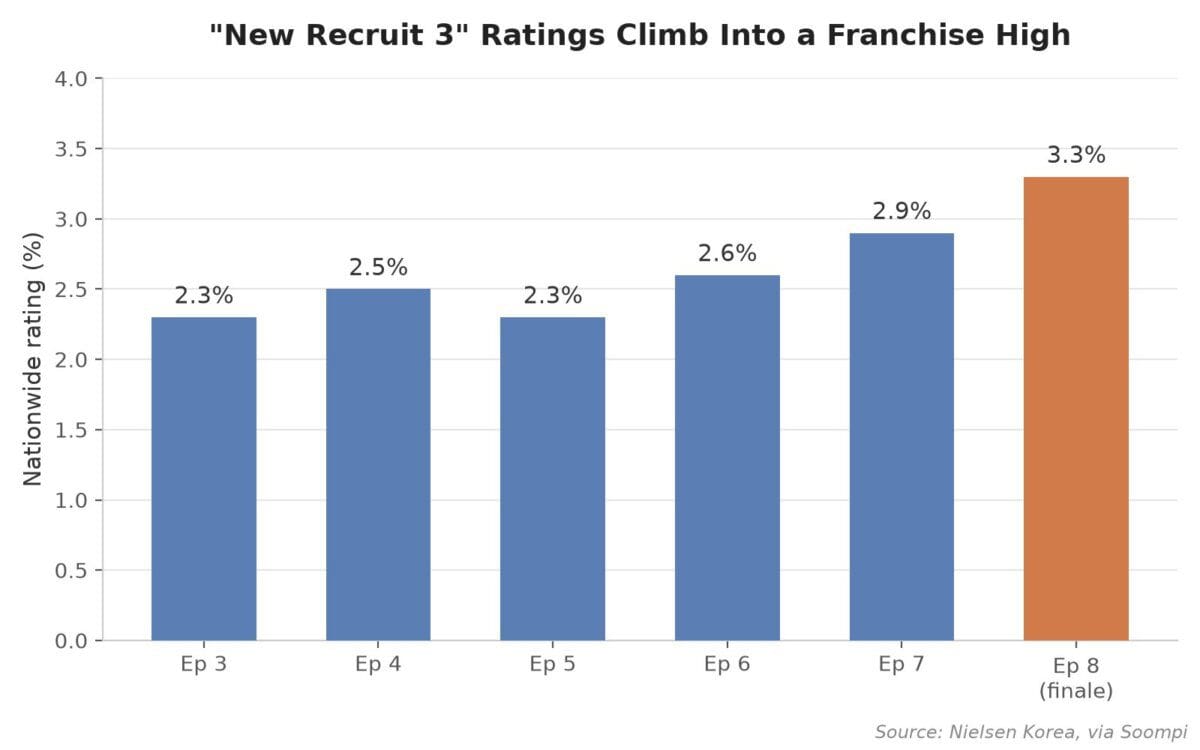
3.3% sounds small next to a U.S. network hit, but Korean cable dramas typically run 1-3% against terrestrial giants, so a military comedy beating most of its cable competition — and still rising — is a real signal. That’s the reputation Season 4 walked into on premiere day.
The part with no U.S. equivalent
Here’s where the comparison breaks down. In America, military service is voluntary; no pop star just vanishes from public life for a year and a half by government order. In Korea, every able-bodied man roughly 18 to 28 is legally required to serve — 18 months Army, 20 Navy, 21 Air Force — no exceptions for chart position.
A group can be at its absolute peak, selling out stadiums, and members still get called up one by one, sometimes years apart, while the group keeps functioning without them. That’s not a scandal — it’s the law. There’s no American reference point for “your favorite artist is legally required to leave mid-career,” which is exactly why it confuses new fans.

K-pop military service, happening in real time
NCT 127 released their seventh album, BLINGY, this August with only five of seven members promoting, since Doyoung and Jungwoo are both currently serving.

SEVENTEEN’s Seungkwan enlists October 26, 2026 — his group loses a main vocalist, and its funniest member, for a year and a half of comebacks they now have to plan around. Meanwhile Jaehyun is set for discharge in early May after enlisting in late 2024. This constant churn is just baseline reality for any Korean boy group with members over 18, and it’s a huge reason comeback timing looks chaotic from outside.
Why it actually matters
Mandatory service isn’t a subplot in Korean pop culture — it’s a shared national experience that shapes how entertainment companies plan everything, years ahead of the actual enlistment date. Fandoms have a whole vocabulary for it. And a comedy that turns that dreaded rite of passage into something genuinely funny isn’t just entertainment — it’s cultural therapy for half the country’s male population, disguised as cable TV.
For foreign fans, that context reframes a lot: why a member “disappears” without much of a goodbye, why groups promote as five instead of seven, why comeback timelines feel oddly precise. It’s not label drama. It’s the law, it’s universal, and now there’s a hit show making fun of it while everyone who lived it nods along.
you might also like



Sources: