Okay so a girl group quietly broke one of their own records at 1:53pm on a random Saturday in Seoul, and I need everyone to understand why it’s a big deal. BABYMONSTER’s DRIP hit 400 million views on YouTube this weekend — now the fastest music video of their career to get there. “Fastest” sounds like a hollow superlative until you put a number next to it, so here are the five that explain what happened and why it matters.
1. The headline number: BABYMONSTER’s DRIP hits 400 million views
“DRIP” dropped on November 1, 2024, as the title track off BABYMONSTER’s first full-length album. It was never the group’s biggest debut-week story — that was “SHEESH” back in April 2024 — but it’s had this weird, slow-burn staying power. It crossed 400 million views on YouTube on August 22, 2026, according to Soompi, which tracks these milestones the way sports blogs track box scores.

For context: YG Entertainment also made BLACKPINK, so BABYMONSTER has been under a specific kind of pressure since debut — every chart placement gets read as “are they the heir apparent,” whether the members asked for that or not.
2. The real flex: 659 days versus 747 days
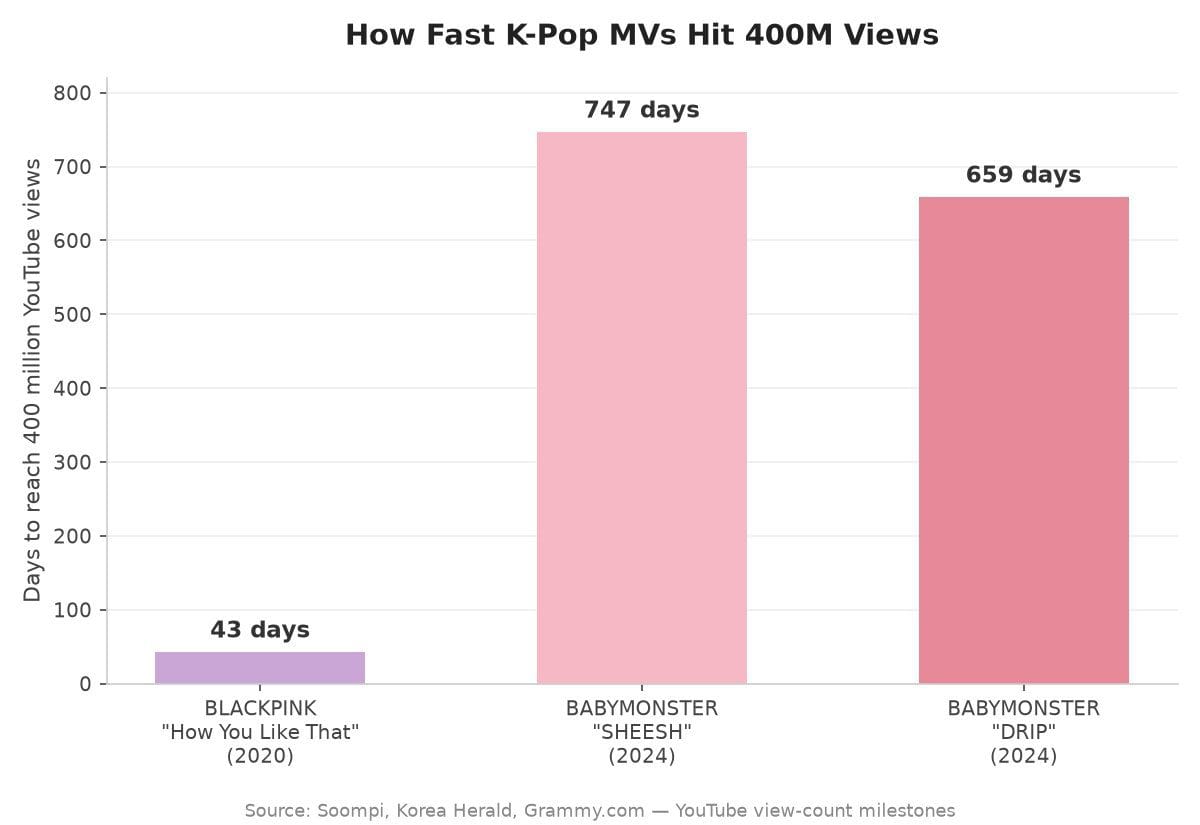
This is the number that actually matters. “SHEESH” took 747 days to hit 400 million views. “DRIP” did it in roughly 659 days — about a year, nine months, and three weeks. That’s 88 days faster, which means DRIP is accumulating views at a meaningfully higher weekly rate than the song that first put BABYMONSTER on the map. A YouTube milestone isn’t about one big opening weekend; it’s the sum of two years of people still clicking play, still using it in edits, still adding it to playlists. Getting there faster means more gravity, not just a bigger launch.
3. The number that puts it all in perspective: 43 days
Now for the humbling part. BLACKPINK’s “How You Like That” hit 400 million views in just 43 days back in 2020, per Grammy.com. Forty-three days. BABYMONSTER’s fastest song is still more than fifteen times slower than that. That’s not a dig — a debut-era BLACKPINK video hitting numbers like that was a freak event that reset what “normal” meant for the whole industry. But it’s the honest yardstick, and the one every BABYMONSTER comeback gets measured against internally at YG, fair or not.

Think of it like a college freshman getting compared to the program’s all-time record holder every game. Technically true, mostly unhelpful, and also the comparison nobody’s going to stop making.
4. Why the timeline actually matters more than the total
Total view count gets the headlines, but time-to-milestone is the number industry people actually watch, because it filters out one-time viral spikes and shows whether a song has real staying power. “DRIP” getting there 88 days faster than “SHEESH” lines up with quieter numbers from the same era: the album became BABYMONSTER’s first release to pass 1 million cumulative sales on Hanteo, and it gave the group its first entry on the Billboard 200, debuting at No. 149. None of those are viral-moment numbers — they’re the boring, compounding kind that predicts whether a group sticks around. A song still gaining speed nearly two years out is a song still being discovered, not just replayed by the same fans.

5. What it signals for where BABYMONSTER goes next
Fans have called BABYMONSTER “5th-gen leaders” for a while now, and this unglamorous data point backs it up better than a chart placement does. Every metric moving the same direction — faster views, more sales, a first Billboard entry — points to a group whose global footprint is still expanding rather than plateauing three years post-debut, usually the danger zone for groups without a generational single. It also raises the stakes on what comes next: if the pattern holds, the next comeback needs to beat 659 days, not 747, or the story flips from “still climbing” to “cooling off.”

So no, 400 million views alone isn’t shocking in 2026 — plenty of songs get there. What’s worth clocking is the acceleration: a two-year-old song still gaining ground, and the real gap between “fastest in the group’s own history” and “fastest in K-pop history” that BABYMONSTER is still working to close. That gap is basically the whole plot of this era, and now you have the receipts.
you might also like



Sources:
- Soompi — BABYMONSTER’s “DRIP” Becomes Their 1st MV To Surpass 400 Million Views
- Korea Herald — BABYMONSTER logs 400m views in record time with “SHEESH” music video
- Grammy.com — “How You Like That”: BLACKPINK Breaks Multiple Records With Latest Music Video
- KpopStarz — BABYMONSTER’s ‘Drip’ Album Becomes Girl Group’s First Million-Seller