Quick question: how many bands can you name where four in ten random Americans — not fans, just people who consume music in general — could tell you who they are? Not many. That’s Beyoncé territory. As of this month, BTS’s popularity in America has technically climbed into it, per actual survey data, not just Twitter vibes.
The number comes from Luminate, the analytics company behind Billboard’s chart data, via a BigHit Music press release on August 14. A raw “survey says X%” headline is usually meaningless without something to compare it to, and this one comes with three built-in comparisons.
The Headline Number, and What It Was Five Years Ago
In Luminate’s Q2 2026 data, 46% of surveyed US music consumers said they view BTS favorably — the highest score since Luminate started tracking them in 2021, when it sat at 34%. Twelve points in five years doesn’t sound dramatic until you remember this stretch covers all seven members doing mandatory military service, with the group barely active as a unit for most of it. Normally, going quiet that long kills momentum. BTS’s favorability went up anyway.

BTS’s Popularity in America vs. Everyone Else in K-Pop
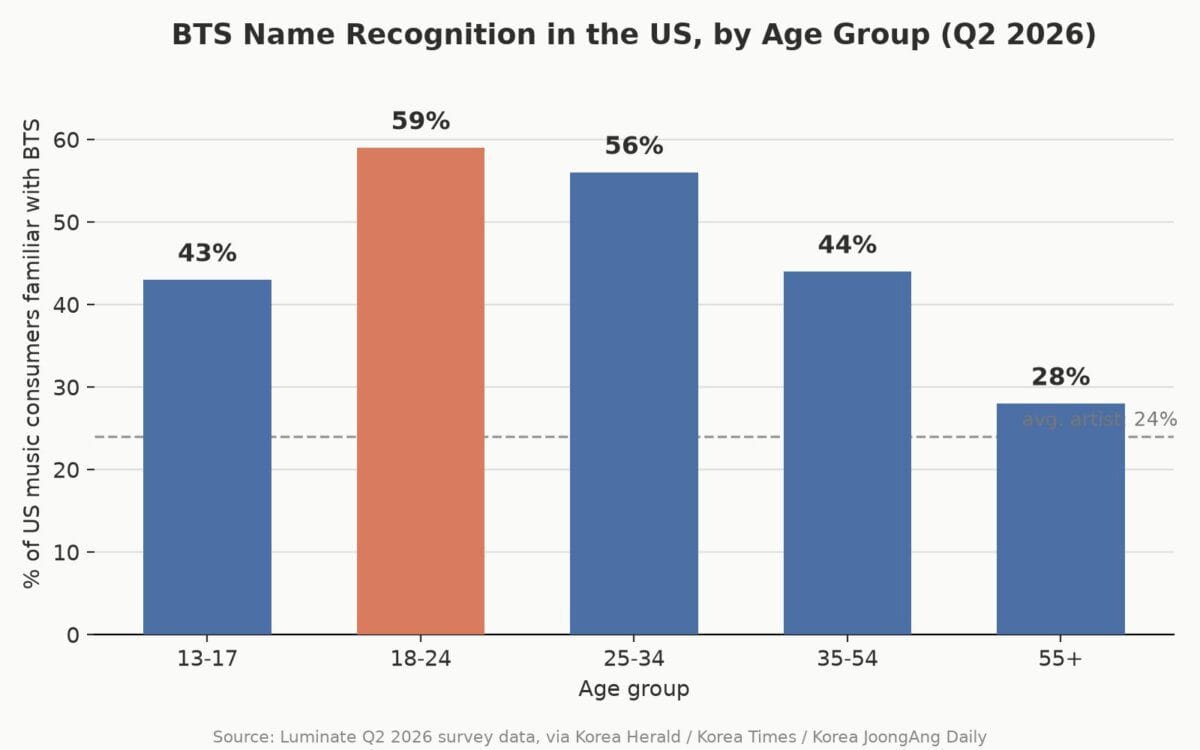
Here’s where it gets more interesting than one flattering percentage. Luminate separately tracks a “familiarity” metric, and BTS scored 42% there. The average recognition rate across all artists surveyed — every genre — is 24%. BTS sits 18 points above the baseline for famous people in general.
Now compare it to their own genre: the average familiarity score among the 22 K-pop acts Luminate tracks is 11%. BTS’s 42% is basically four times that. That’s the gap between “a band your local scene knows” and “a band your mom has heard of.” Most K-pop acts, even huge ones by industry standards, are still fandom-only visible in the US. BTS broke out of that lane a while ago, and the gap isn’t closing — it’s widening.
Who’s Actually Recognizing Them
The age breakdown should reframe how you think about the BTS Army — it’s not what the stereotype assumes. Familiarity peaks with 18-to-24-year-olds at 59%, but 25-to-34-year-olds aren’t far behind at 56%. The 35-to-54 bracket clocks in at 44%, still above the all-artist average of 24%. The only soft spot is 55-plus, at 28% — true of basically every act that debuted after 2010. This isn’t a small, intensely loyal teen fanbase. It’s recognition that spans three adult generations.
One more detail from BigHit’s own breakdown: of Americans aware of BTS, 26% are “engaged” with the music, 15% show strong affinity, and 9% qualify as superfans, all up year-over-year. And 7% of that “aware” group are self-identified hip-hop listeners who don’t normally touch K-pop — genuine genre crossover, not just fandom growth.
Why Now? The World Cup Halftime Show Timing Isn’t a Coincidence
Survey timing matters, and this one lines up with BTS’s highest-visibility American moment in years. The group played the halftime show at the 2026 FIFA World Cup final on July 19, a broadcast reaching an audience several multiples larger than any award show slot a K-pop act would normally get. Off that single performance, BTS’s album jumped back into the Billboard 200’s top 10. Two days earlier, they’d closed the European leg of their Arirang World Tour with a sold-out show at Stade de France in Paris.

So this isn’t a random favorability bump — it’s a group that just had a full world tour and a globally broadcast halftime slot in the same six-week window, measured right as both were landing.
Why This Actually Matters
For American readers who mostly know K-pop as “that thing my roommate is really into,” this is the data version of something that’s been building for a while: BTS isn’t a subculture act anymore. A brand weighing a Super Bowl ad, a network eyeing a major broadcast slot, or a rival label plotting its own US strategy are all reading the same signal — familiarity above 40% among general music consumers is roughly the threshold where an act stops needing an introduction. BTS crossed it, then kept climbing, through a mandatory hiatus most acts wouldn’t have survived. For an industry that’s spent a decade guessing whether K-pop’s US ceiling was fandom-sized or mainstream-sized, that’s the answer.

you might also like



Sources:
- Korea Herald — “Four in 10 US music consumers familiar with BTS: survey”
- Korea Times — “BTS favorability among US fans hits record high: Luminate data”
- Korea JoongAng Daily — “BTS’s US favorability hits record 46% in Q2 poll”
- Headline Planet — BigHit’s Luminate data breakdown on engagement and affinity