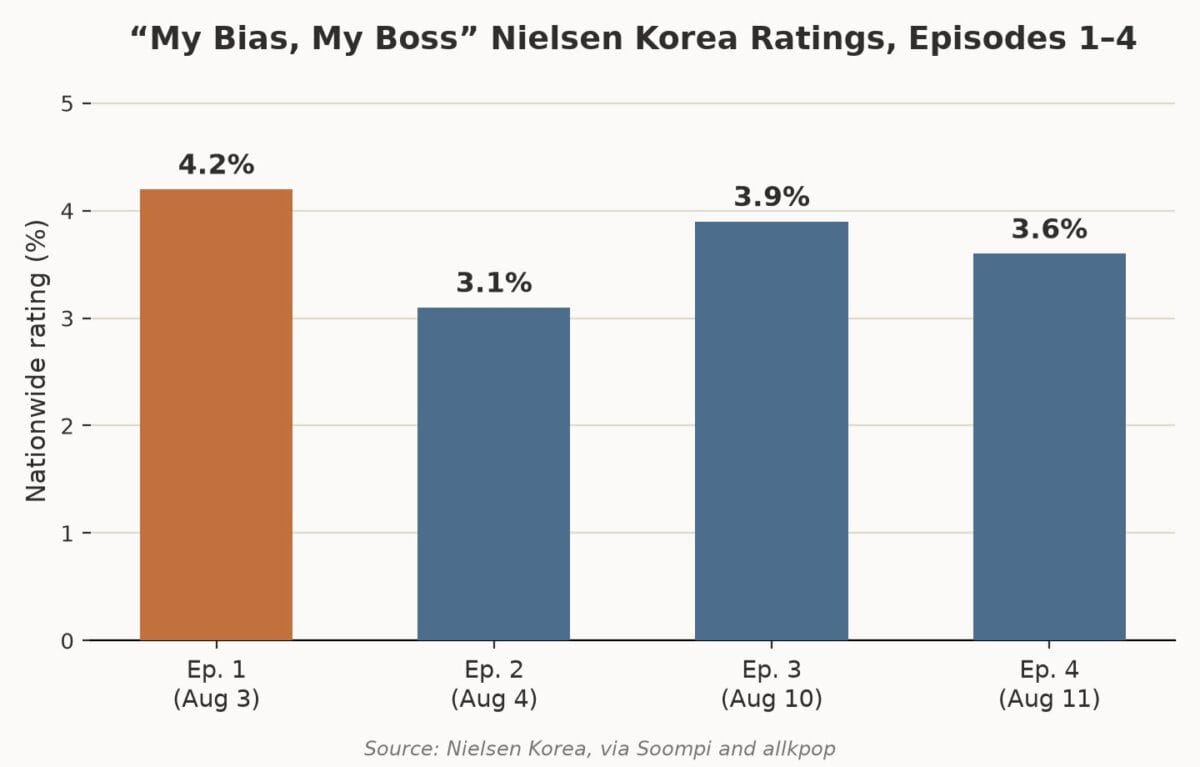
Somewhere in Seoul this month, a fictional 24-year-old named Nam Da-reum got hired at a fashion startup, found out her actual co-worker is the K-pop idol she’s been stanning for thirteen years, and then watched her grumpy CEO boss turn into the real romantic lead anyway. That is the entire premise of “My Bias, My Boss,” tvN’s new Monday-Tuesday drama, and it is not a fanfiction AO3 tag, it’s a real show with real Nielsen numbers that Korea has been checking obsessively since August 3rd. I watched the ratings do an actual rollercoaster over four episodes and I need to walk you through why, because it says something bigger than “cute rom-com exists.”
Wait, What Is This Show Actually About?
The plot, real quick: Nam Da-reum (played by Kim Hye-jun) has been a fan of idol-turned-entrepreneur Lee Chan (Cha Woo-min) since middle school. She lands a job at his fashion company without realizing he’s a co-founder, spends the first act hiding her fangirl identity, and gets tangled up with the short-tempered CEO, Kang Ha-gi (Kang Hoon) — who happens to be Chan’s childhood best friend. It’s a love triangle where one guy is the fantasy and one guy is the actual, inconvenient, in-real-life crush. Twelve episodes, tvN, still airing.Photo: Kinocine, CC BY-SA 4.0, via Wikimedia Commons.
Okay But What Does “Bias” Even Mean
If you’re new here: in K-pop fan speak, your “bias” is your designated favorite member of a group — the one you’d theoretically maim someone for. It’s a fandom loanword that’s stuck around so hard it shows up in actual dictionaries of internet slang now. Having a bias is basically a rite of passage for any K-pop fan, and “My Bias, My Boss” is doing something clever by taking that specific, extremely parasocial relationship and asking: what if you actually had to see your bias at the coffee machine every day? Would the fantasy survive printer jams and Slack messages? The show’s answer, four episodes in, is “sort of, but the real guy standing in front of you is more interesting than the poster on your wall” — a more emotionally mature thesis than I expected from a Monday night drama.Photo: Caleb Oquendo, via Pexels.
The Ratings Rollercoaster, By the Numbers
Here’s where it gets genuinely interesting. According to Nielsen Korea data compiled by Soompi and tracked on Wikipedia, the premiere pulled a 4.226% nationwide rating on August 3rd — a strong open for a cable drama, and close behind the previous occupant of that timeslot, “See You at Work Tomorrow!”, which allkpop reported ended its run at 4.5%. Then episode 2 dropped hard to 3.143%, which is the kind of dip that makes a network nervous. But instead of continuing to slide, it rebounded to 3.870% for episode 3 and settled at 3.558% for episode 4 — and per Soompi, that’s the show’s best-ever Tuesday number. For context, competing timeslot drama “Dream to You” on ENA has been hovering around 2.0-2.5% this same stretch, so despite the wobble, “My Bias, My Boss” has stayed the No. 1 non-terrestrial drama every single week it’s aired.Data: Nielsen Korea, via Soompi and allkpop.
This Isn’t the First “Secret Fangirl” Drama, But the Timing Matters
If the premise sounds familiar, that’s because K-dramas have quietly built a whole subgenre around it — “Business Proposal” and “Her Private Life” both ran the same play (ordinary woman secretly loves a celebrity, ends up working near/dating him) and both became genuine international hits, the kind that show up on Netflix’s global Top 10. “My Bias, My Boss” is arriving at a moment when K-pop’s biggest export isn’t really the music anymore, it’s the fandom infrastructure around it — the bias culture, the parasocial economy, the entire vocabulary of stanning. A drama literally titled after a fan term, airing on the network that also makes actual K-pop content, isn’t a coincidence; it’s the industry recognizing that the fantasy of “what if I dated my bias” is worth more as a story than as a subtext.Photo: Yohan Cho, via Unsplash.
Why This Actually Matters
The bigger signal here isn’t one drama’s ratings, it’s what the premise assumes about its audience: that international viewers already speak fluent K-pop fandom, no subtitles needed for “bias.” Global streaming numbers for K-dramas keep climbing specifically because shows like this one don’t dumb down the culture, they lean all the way in. If you’re the kind of person who has ever said the words “my bias” out loud without irony, this show was built in a lab for you, ratings dip and all.Photo: Ron Lach, via Pexels.