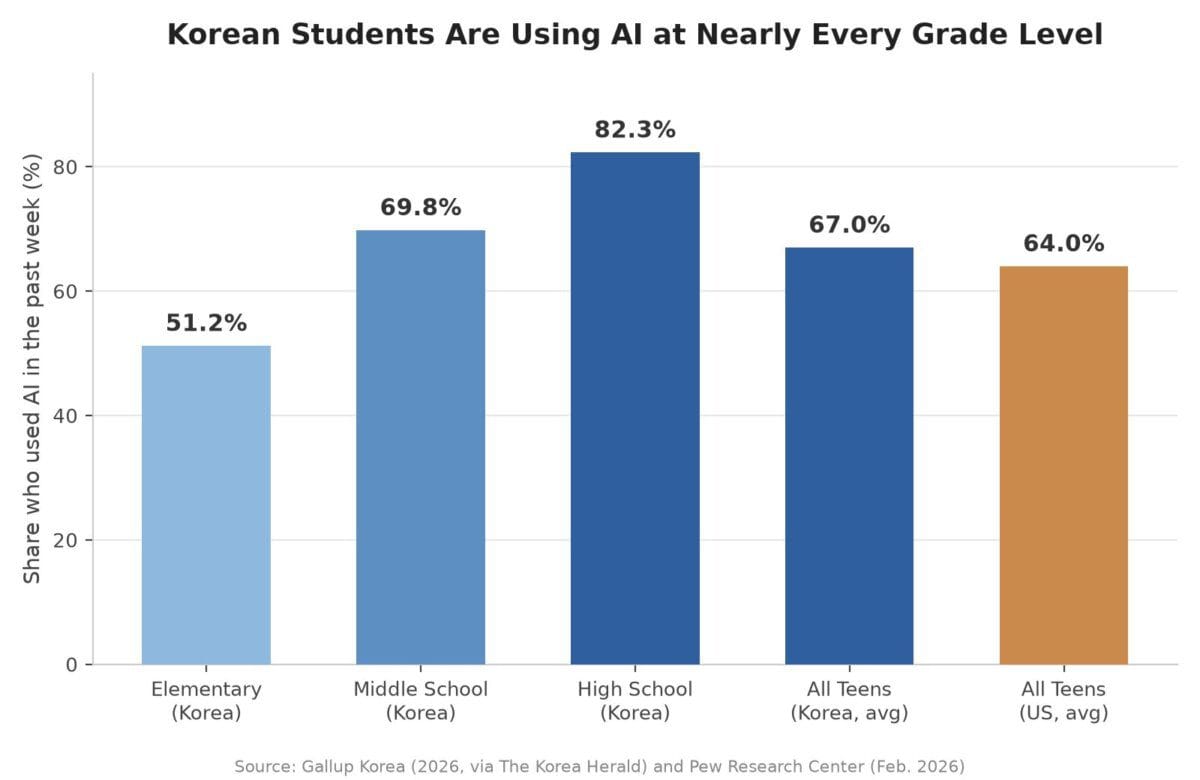
82.3 percent. That’s the share of Korean high schoolers who used AI in a single week, per Gallup Korea polling of 2,674 students. I read that, checked the American equivalent, then recalculated because I assumed I’d mixed up the columns. I hadn’t. Korean Gen Alpha — kids born roughly 2010 to 2024, the first cohort never to know a world without a chatbot — makes my “is it cheating if I ask ChatGPT to outline my essay?” hand-wringing look adorably quaint.
The oldest of them turn 20 in four years, so The Korea Herald took a look at the generation right before it arrives. Here’s how they stack up against us, round by round.
Round 1: Raw Usage — Closer Than You’d Think
Gallup Korea surveyed fourth graders through high school seniors. Sixty-seven percent had used AI in the previous week: 82.3% of high schoolers, 69.8% of middle schoolers, and — the one that made me put my phone down — 51.2% of elementary schoolers. Fourth graders, weekly, at an age when my peak tech achievement was a Club Penguin igloo.
America’s number: Pew Research Center found in February 2026 that 64% of US teens use chatbots, 54% for schoolwork. So on headline usage we’re basically neck and neck — 64 versus 67. Not the blowout I expected.
Round 2: What They Do With It — Korea Wins Decisively
Here the comparison stops being close. Pew found the most common American use is “researching a topic,” with 10% of US teens using chatbots for all or most of their homework. Translation: we mostly treat it as a faster Google with a personality.
Korean students use it differently. A survey by the Jinhak Educational Assessment Research Institute, reported in March 2026, found that when Korean high schoolers study with AI, 49.7% ask it to explain concepts they don’t understand and 29.0% ask for problem-solving guidance — versus 27.9% who use it to summarize. The dominant mode is tutoring, not outsourcing. One habit builds understanding you keep; the other builds a dependency you don’t notice until the exam.

Round 3: The Part Where Korean Teens Skip College Entirely
Now the wild bit. The Herald profiles Yoon Yeo-jun, a 15-year-old who shipped an app called Wayver with zero formal coding training — he “vibe coded” it, describing what he wanted to an AI and iterating. He’s on his second app. At Versework, a Korean game studio, roughly 10% of its ~50 employees are teenagers, some in executive roles. Several left school to work full time.
Understand how heretical that is here. This is the country of the suneung, an entrance exam so consequential that planes are grounded during the English listening section and the stock market opens late. The contract has been ironclad: grind through hagwon (cram school), ace the suneung, enter a SKY university (Seoul National, Korea, Yonsei), land the conglomerate job. A 15-year-old shipping software instead isn’t a side hustle. It’s a defection from the national operating system.

Why It Matters: The Demographic Time Bomb
Here’s the context that reframes all of it. Korea’s population is projected to fall from 51.6 million to 36.22 million by 2072 — roughly 30% of its people gone in fifty years. Korea has the lowest fertility rate on earth. There’s no version of the future where enough Korean workers exist to run the economy the old way.
So Gen Alpha’s AI fluency isn’t a lifestyle trend — it’s arguably the mitigation strategy. If each remaining worker is far more productive because they’ve collaborated with AI since fourth grade, the math on a shrinking workforce gets less apocalyptic. Korea is semi-accidentally running the world’s most aggressive experiment in whether AI-native humans can offset population collapse.
The entrepreneurship data suggests it’s already moving: of 1.14 million businesses launched in Korea last year, 418,000 (36.8%) were founded by people 39 or younger, with tech-based startups up 2.8% to 221,000.
The Line That Stuck With Me
One Korean student told the Herald: “We spend a lot of time using AI. I think I probably spend more time talking to AI than to real people.”
I wanted to be snarky. I couldn’t, because I checked my own screen time afterward and did not love the results. The real difference isn’t that Korean kids are weirder than us — it’s that American teens stumble into this individually, one assignment at a time, while Korean society is speed-running it collectively with a shrinking nation’s pressure behind it. Same direction. Korea just got a head start, and a more urgent reason to run.

you might also like


Sources
- The Korea Herald — “In 4 years, Generation Alpha begins coming of age. What will it mean for Korea?” (Aug. 17, 2026)
- The Korea Herald — “Nearly half of Korean high school students use AI weekly for studies: survey” (Mar. 11, 2026)
- Pew Research Center — “How Teens Use and View AI” (Feb. 24, 2026)
- Asia News Network — Generation Alpha in South Korea