173,000. That’s how many first-week units KATSEYE’s new EP WILD pulled on the Billboard 200 — enough to land the group its first-ever No. 1 album in the US, reported by HeadlinePlanet on August 22. If you’ve never heard of KATSEYE, don’t worry, I’m about to explain the whole weird, genuinely fascinating deal. If you have, stick around, because the KATSEYE Billboard 200 debut is a lot more interesting than “girl group hits No. 1” makes it sound. Here are the five numbers that actually explain why.
1. 173,000 — the number that put them at No. 1
WILD sold roughly 147,000 US copies during its August 14–20 tracking week, and with streaming and track sales folded in, that’s 173,000 total units — enough to “convincingly” top the chart, per HeadlinePlanet’s report. For scale: the week before, Stray Kids’ This & That moved 362,000 total units. K-pop’s biggest boy groups still operate in a different tier of fan-army mobilization. KATSEYE’s smaller number is a No. 1 built more on radio and general pop streaming than a coordinated album-buying blitz — which honestly makes it the more surprising win.

2. 44,000 → 173,000 — the jump from their last EP
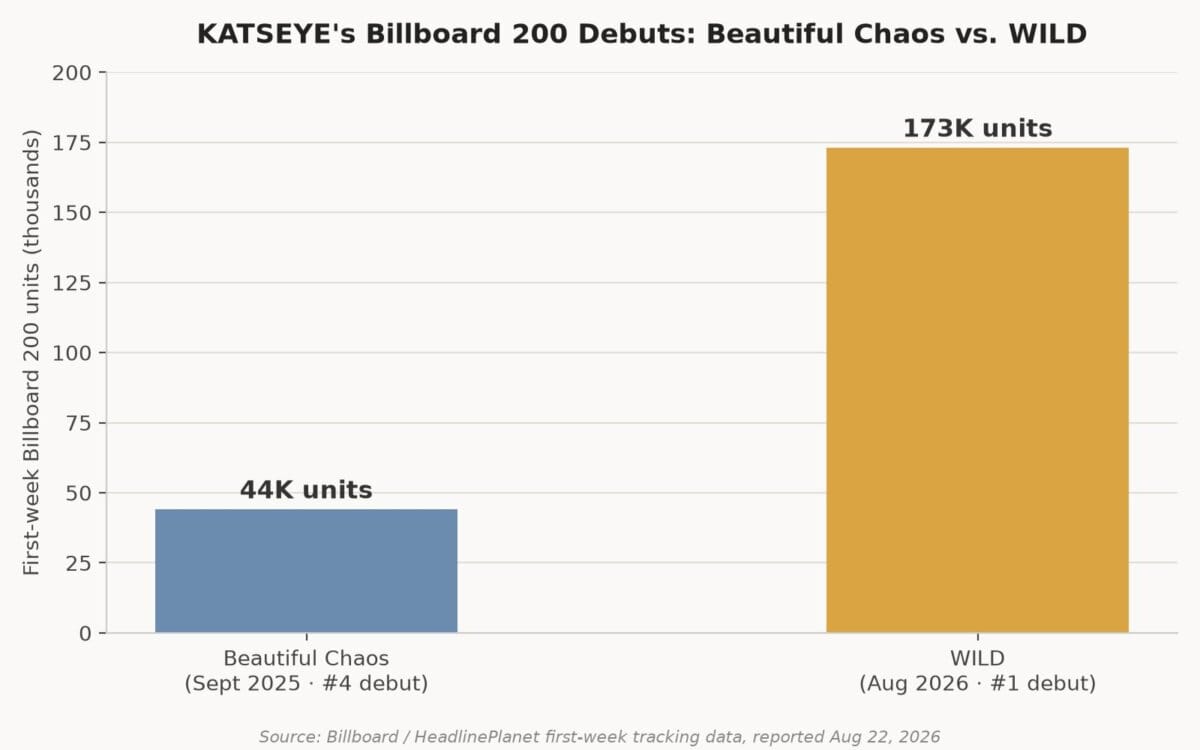
Their previous EP, Beautiful Chaos, debuted at No. 4 in September 2025 with 44,000 units. WILD nearly quadrupled that number and flipped a No. 4 into a No. 1 — also giving them the No. 1 spot on the Billboard Top Album Sales chart. Industry trackers have been calling it the biggest girl-group Billboard 200 debut of the 2020s so far. Going from “solid mid-chart EP” to “biggest debut of the decade for your category” in under a year isn’t a normal trajectory — most acts plateau after their breakout, and KATSEYE instead built momentum.
3. 53 weeks — proof this isn’t a fluke
Beautiful Chaos didn’t just chart and disappear — it stayed on the Billboard 200 for 53 straight weeks, per the Korea Herald, making KATSEYE the first female group in 21 years to spend a full year on that chart, since the Pussycat Dolls’ PCD back in 2005. They also reportedly hold the highest monthly Spotify listener count of any girl group on Earth, over 32 million. A No. 1 debut week is a headline. A year-long chart run is proof people are still listening in month eleven, which is the harder thing to fake.
4. So wait, what actually IS KATSEYE?
Fair question if this is your first time hearing the name. KATSEYE is a six-member group (five appear on WILD — Manon Bannerman has been on health-related hiatus since February 2026) formed in 2023 through “The Debut: Dream Academy,” a joint venture between HYBE — the Korean company behind BTS — and Geffen Records/UMG. The members are American, Filipino, Swiss-Ghanaian, and South Korean; the group trains like a K-pop act (grueling trainee system, tightly produced comebacks, multi-part rollout singles) but is marketed in English, out of Los Angeles, at a Western pop audience. It’s less “K-pop crossing over” and more “the K-pop machine, exported” — which is why the UK numbers matter too: WILD debuted at No. 2 on the UK Official Albums Chart, their first-ever UK top 50 album, and the first girl group since Little Mix in 2021 to land five UK top 40 singles in one calendar year.

5. Why this actually matters
BTS and BLACKPINK broke America as Korean acts selling Korean-ness to a global audience. KATSEYE is the opposite bet: take the K-pop production system — the training pipeline, the comeback choreography, the relentless content cadence — and use it to build an American-fronted group from zero that competes on Billboard’s own turf, no translation needed. A Billboard 200 No. 1 and a UK top 5 album suggest HYBE just proved the system itself is the exportable product, not just the artists trained inside it. Expect other Korean agencies to try the same playbook on non-Korean rosters now that there’s proof it works.

So next time someone tells you KATSEYE “isn’t really K-pop,” you can hit them with the receipts: trained like a K-pop group, funded by a K-pop company, charting like nothing a girl group has in two decades. Whatever you want to call the genre, the numbers don’t care.

you might also like


Sources:
- HeadlinePlanet — Report: KATSEYE’s “WILD” Debuts At #1 In United States With 147K Sales, 173K Total Units
- Korea Herald — Katseye charts 1 year on Billboard 200 with 2nd EP
- Ratings Game Music — KATSEYE’s “WILD” Projected for No. 1 Billboard 200 Debut With 172K Units
- Official Charts — KATSEYE score fifth Top 40 hit of 2026 with Hootie Frutti
- Wikipedia — Wild (Katseye EP)